January 24, 2025
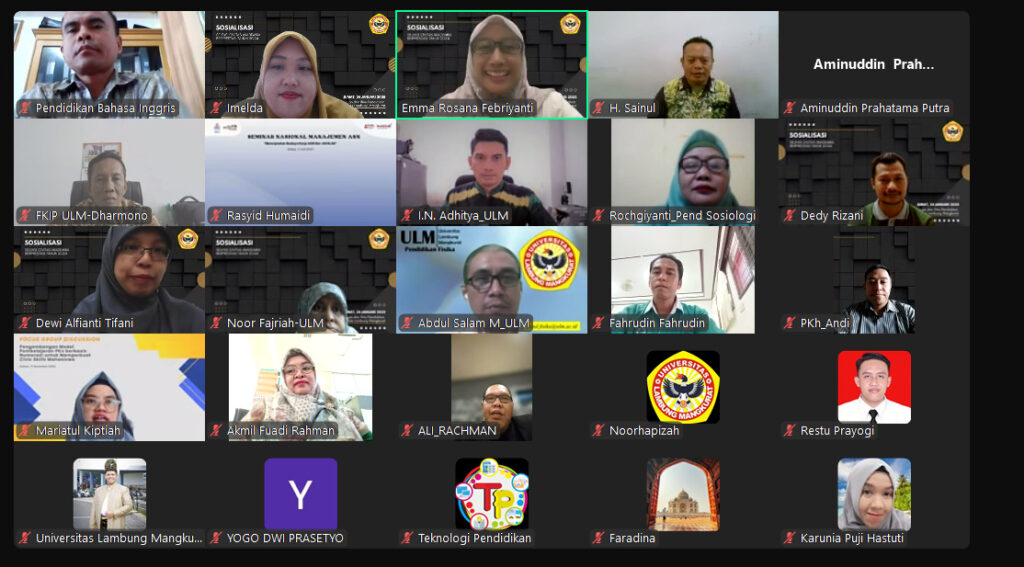
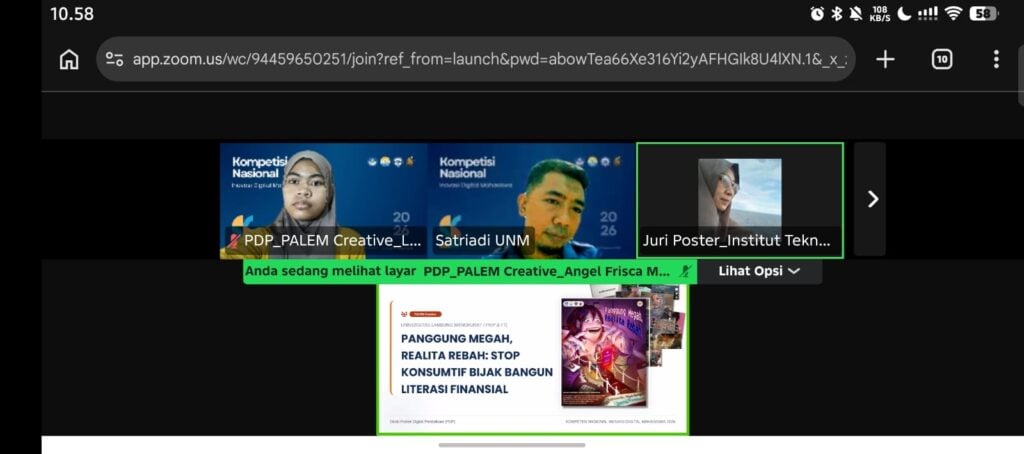
Banjarmasin – The Faculty of Teacher Training and Education (FKIP) at Lambung Mangkurat University (ULM) will hold the 2024 Outstanding Academic Community Selection event in January-February 2025. This activity is part of the faculty’s innovation program as part of its efforts to achieve the 2025 FKIP ULM Program Performance Indicators (IKP). Information about this activity was disseminated on Friday, January 24, via a Zoom conference starting at 10:00 a.m. WITA. The socialization event was hosted by the Head of the Cooperation and Public Relations Management Unit (UPKH), Emma Rosana Febriyanti, with the Deputy Dean for General Affairs and Finance, Dharmono, acting as the guest speaker. The event was opened by the Dean, Sunarno Basuki, and attended by the Deputy Dean for Academic Affairs, Deasy Arisanty; the Deputy Dean for Student Affairs and Alumni, Ali Rachman; Program Coordinators (Korprodi) within the FKIP ULM, Sub-Coordinators within the FKIP ULM, the Head of Security and Cleaning Service (CS) who are part of the faculty’s educational staff (tendik), as well as the faculty-level selection committee.
In his opening remarks, Sunarno Basuki expressed his appreciation for this innovation program. According to him, selecting the best-performing members of the academic community was actually part of a plan to show appreciation for the best performance of lecturers, students, and teaching staff at FKIP ULM. He hoped that this inaugural event would be a success. In his presentation, Dharmono explained that the purpose of this activity was to improve the performance of the academic community, as well as to show appreciation and maintain the quality of FKIP. According to him, in the context of institutional accreditation, showing appreciation for the performance of the academic community is an important point in maintaining the governance and management of the institution.
This socialization explained the requirements for lecturers, students, and teaching staff who could participate in the selection, as well as the selection and assessment process. The selection process was carried out in two stages, namely the selection of lecturers and students at the PS level by the study program coordinator and secretary. For teaching staff, the selection in the form of assessment was carried out by the immediate superior of each teaching staff member. Each PS then sends its best candidate, while the staff assessors collect all assessment documents at the faculty selection committee. At the faculty level, the selection team ranks the collected data and selects the top three lecturers and students to give presentations, which are assessed by a panel of judges to determine the first, second, and third place winners. Meanwhile, for teaching staff, the selection of the top 3 to give presentations applies to teaching staff in the faculty category, while for other categories such as PS operators, laboratory assistants, CS, and security, the highest ranking results will be used without presentations.
The indicators for selecting lecturers are evidence of support in the implementation of the three pillars of education, research, and community service. Meanwhile, the indicators for selecting students include academic achievements such as Grade Point Average (GPA) or research publications and non-academic achievements which include achievements in competitions and/or certificates of competence in a particular field of expertise. The indicators for technical staff performance include assessments of initiative, service, and teamwork.
“Regarding the form of appreciation, we certainly strive to give appropriate recognition, but we must still refer to the rules for giving gifts set by the Ministry of Finance and implemented at ULM,” concluded Dharmono in his presentation. (admin)