09/04/2025
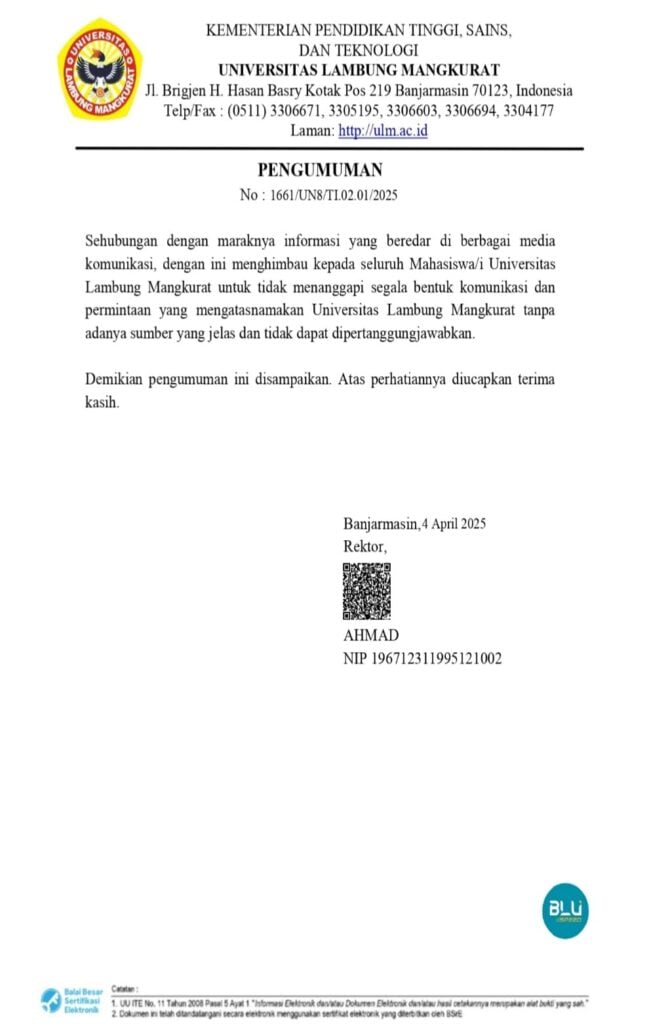
Banjarmasin – The academic community of the Faculty of Teacher Training and Education (FKIP) of Lambung Mangkurat University (ULM) is urged to increase their awareness of various modes of fraud through short messages, WhatsApp messages, and telephone calls. This type of fraud is increasingly widespread on behalf of various agencies, ranging from the Lambung Mangkurat University (ULM) campus, banks, to the police with victim losses reaching tens of millions of rupiah. The Rector of ULM himself in the announcement number 1661/UN8/TI.02.01/2025 dated April 4, 2025 which can be seen on the Simari account conveyed a warning that the ULM academic community should not respond to various forms of communication and requests on behalf of ULM or personal ULM academic community from sources that are unclear and cannot be accounted for.
In line with this, the Deputy Dean for Student Affairs and Alumni, Ali Rachman on Wednesday, 09/04 conveyed a special message to students to be more careful not to get caught in this fraud trap. According to him, students are expected to be vigilant if they receive links to click from sources of unclear origin, “Do not just click on links in text messages, first read the contents of the message carefully. If you receive a call whose number is not stored in your contact data, students also need to be more vigilant. If the caller seems to know exactly about you, students should be suspicious, lest the data has been leaked and held by the caller to influence students. Then usually, the caller also says not to say anything to anyone if the student gets a call. This already indicates an indication of fraud. Ask or ask for help from friends or closest people if students are asked to go to an ATM when receiving a phone call of unclear origin, this way it can minimize or prevent students from being hypnotized or affected by the caller’s persuasion. Students also need to pay attention to information from campus, especially with fraud modes or circulars from campus related to fraud modes so that they can be avoided, “he explained. Information on various modes of fraud can also be conveyed to the campus audience so that more victims do not fall.
Muhammad Arsyad, a lecturer in the Guidance Counseling Study Program who is also a Master in psychology, shared some tips on how to deal with these types of scams. According to him, it is important not to be reactive to messages or calls from unknown numbers. “Give a pause between the time of receiving the message and the response given. The pause period will help us think more rationally. Also, make sure we verify if the call is on behalf of a certain person or institution,” she said.
According to Arsyad, although most of us have heard or read information on various scams, many are still deceived. This is because in addition to the increasingly sophisticated modus operandi of this digital-based fraud, another influencing factor is that fraudsters take advantage of the panic of potential victims. Fraudsters usually use an emergency mode that makes potential victims feel pressured to transfer money immediately. Banking literacy is also important regarding the transfer process and account confidentiality in order to avoid fraud.
For those who have already been deceived, Arsyad provides tips on psychological recovery. According to him, the first important thing is not to blame yourself too much. The chances of being deceived are smaller when one is vigilant, and anyone can be in an unwary state. “We need to think positively to make this a lesson so as not to be trapped in bigger losses in the future. We can also share this experience with people we trust to get positive validation. If it is so psychologically disturbing that it causes depression, it is best to seek professional help such as a psychologist,” he explains. According to Arsyad as well, we should still report to the police regarding this fraud. (admin)