October 1-4, 2025

The Head of Information and Communication Technology (ICT) at the Faculty of Teacher Training and Education (FKIP) of Lambung Mangkurat University (ULM), Nuruddin Wiranda, was selected to participate in the National Vertical Rescue training at the 2025 Harau Cliff Festival held in Lembah Harau, Payakumbuh, West Sumatra from Wednesday to Saturday, October 1-4. One hundred participants were selected from various regions, including three participants from South Kalimantan, followed by participants from West Sumatra, Jambi, Riau, Bengkulu, Aceh, North Sumatra, South Sumatra, Lampung, Banten, DKI Jakarta, Central Kalimantan, West Java, Central Java, and East Java. All participants received accommodation facilities from the organizers.
Wiranda stated that vertical rescue is closely related to the field of Information Technology (IT), especially in supporting communication, coordination, and digital mapping of evacuation locations. This training aims to improve the competence of rescue workers and minimize the risk of fatal accidents. In this activity, participants are provided with various important materials, including:
1. Basic and Advanced Rope Access Techniques for Evacuation
2. Introduction and Use of Vertical Rescue Equipment
3. Techniques for Setting Up Safe Rope Systems
and Anchor Points 4. Simulation of Evacuating Victims at Height and in Confined Spaces
Thus, it is hoped that participants will be better prepared and more skilled in carrying out rescue missions in dangerous terrain.
In modern rescue operations, IT plays an important role in supporting communication, coordination, and digital mapping of evacuation locations. Interestingly, the principles of rock climbing and vertical rescue, such as discipline, risk management, teamwork, and the precise use of equipment, are in line with the values required in IT work. Both require careful planning, precision, and problem-solving skills under pressure, – Wiranda.
Vertical rescue is a rescue technique used in hard-to-reach locations, such as high cliffs, confined spaces, and areas with dangerous access. This training is considered very important in improving the competence of rescue workers while minimizing the risk of fatal accidents during evacuation operations. In addition to strengthening the network of rescue volunteers, this activity also opens up opportunities for integration with information technology, so that future rescues can be carried out more effectively, quickly, and in a coordinated manner.
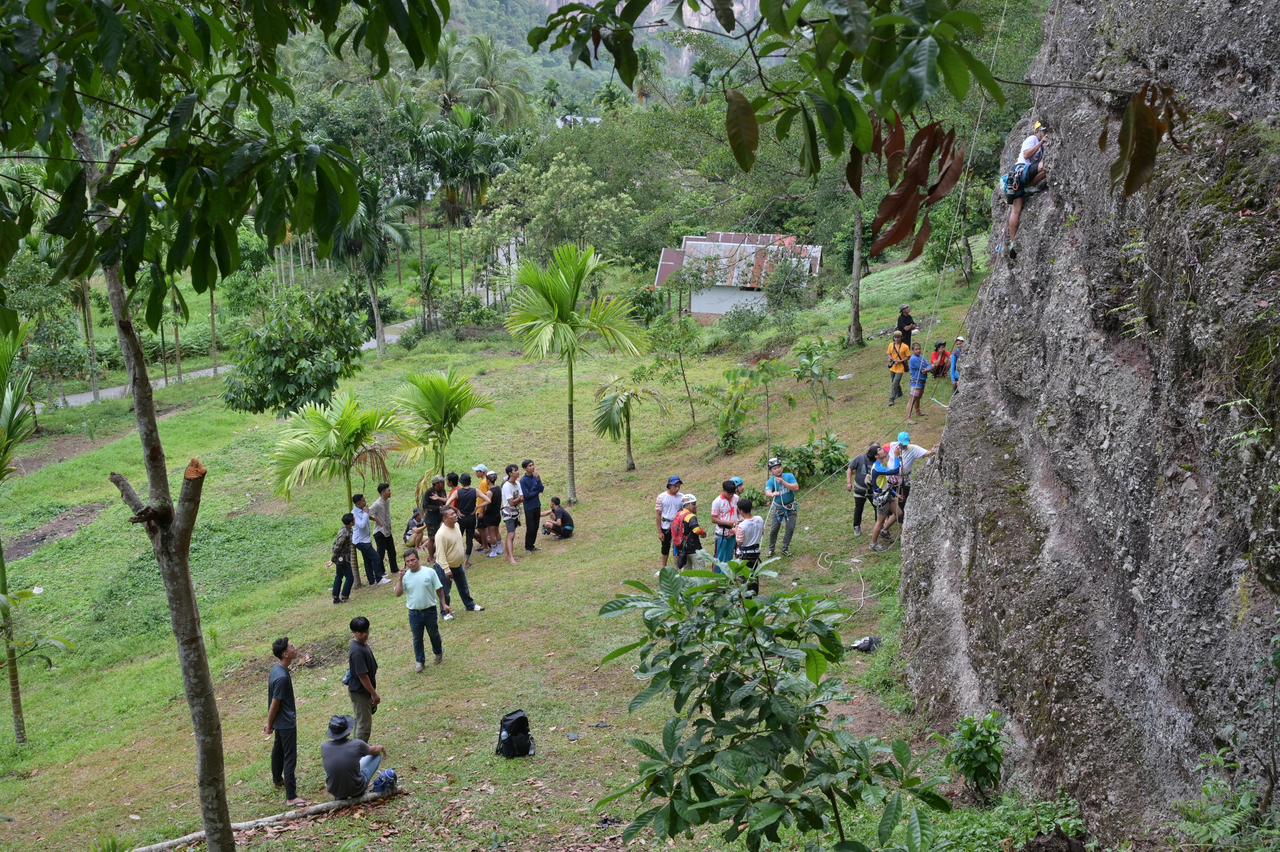
Multi-pitch Rock Climbing Training Atmosphere (doc. Wira)
(Article Contributor: Nuruddin Wiranda)
(Administrator)