June 11, 2026
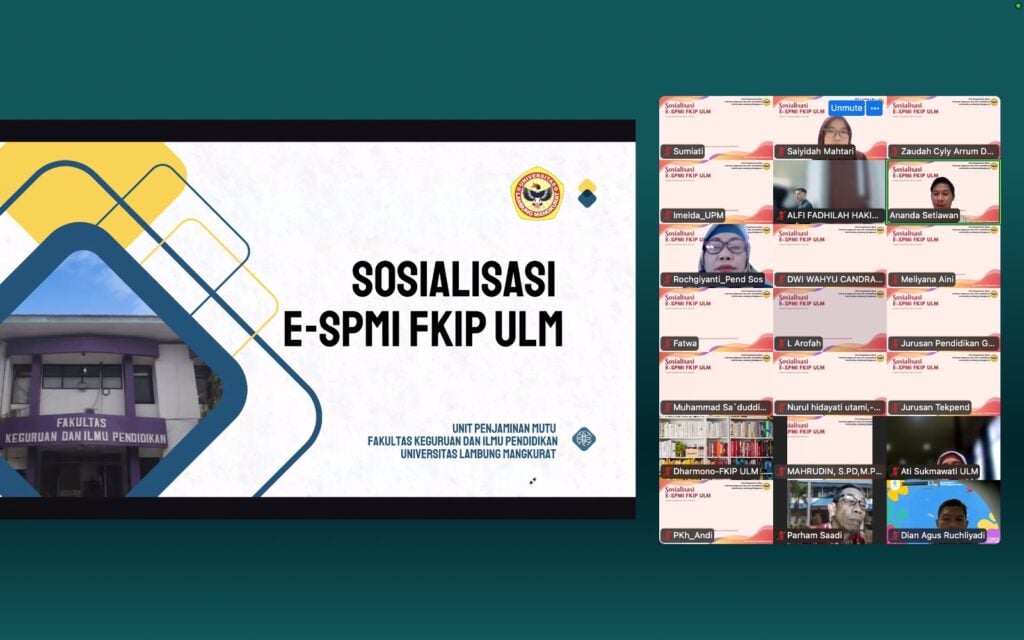
Banjarmasin – The Faculty of Teacher Training and Education (FKIP) at Lambung Mangkurat University (ULM) continues to strive to strengthen its culture of quality through the development of a digital-based quality assurance system. This commitment was demonstrated through an online orientation session on the FKIP ULM E-SPMI Application, organized by the FKIP ULM Quality Assurance Unit (UPM) and attended by faculty leadership, department coordinators and secretaries, the Quality Assurance Task Force (GPM), faculty members, and the FKIP ULM UPM team. The event took place on Thursday, June 11, starting at 9:00 a.m. WITA via a Zoom conference.
The event was opened by Deasy Arisanty, Associate Dean for Academic Affairs at the Faculty of Teacher Training and Education (FKIP) of ULM, who emphasized the importance of utilizing information technology to support the implementation of the Internal Quality Assurance System (SPMI). According to her, the digitization of the quality system is a strategic step toward achieving effective, transparent, and sustainable academic governance.
The implementation of E-SPMI is part of FKIP ULM’s efforts to strengthen a culture of quality while maintaining the sustainability of its excellent accreditation status across all FKIP ULM study programs. This system is expected to support more effective, well-documented, and data-driven quality management, thereby facilitating the evaluation and decision-making processes.
The presentation was delivered by Ananda Setiawan, Chair of the UPM FKIP ULM. In his presentation, he explained the background, objectives, and development of E-SPMI as a reliable information technology tool to support the implementation of the Internal Quality Assurance System. This application, which began development in 2025 and was implemented in 2026, is designed to strengthen the implementation of the Setting, Implementation, Evaluation, Control, and Improvement (PPEPP) cycle and to support the process of completing the faculty-level Internal Quality Audit (AMI) in a more systematic and integrated manner. “We developed E-SPMI to ensure that all stages of the PPEPP cycle are well-documented and easily traceable. In addition, this system also supports the completion of faculty-level AMI by providing integrated quality data and documents so that the quality evaluation process can be carried out more effectively,” he explained.
Next, Saiyidah Mahtari, a member of the ULM FKIP UPM, presented a tutorial on using the E-SPMI application. In this session, participants were introduced to the system’s workflow, ranging from managing PPEPP documents, uploading supporting evidence, and filling out the faculty-level AMI instruments, to utilizing the various monitoring and reporting features available in the application. E-SPMI was developed as an integrated platform that links quality documents, evidence of PPEPP implementation, evaluation results, quality improvement follow-up actions, and data requirements for the Internal Quality Audit (AMI). This system provides various features such as a quality document repository, PPEPP documentation, monitoring of follow-up actions on evaluation results, and a menu for filling out the faculty-level AMI instrument, which can be utilized by all work units within FKIP ULM.
Through the implementation of E-SPMI, the FKIP at ULM hopes that the implementation of PPEPP and AMI at the faculty level can proceed more effectively, in a measurable manner, and with proper documentation. This system is expected to serve as the foundation for strengthening a digital-based culture of quality while supporting the continuous improvement of academic and non-academic governance within FKIP ULM.
(Article Contributor: Saiyidah Mahtari)
(Admin)